Client Login

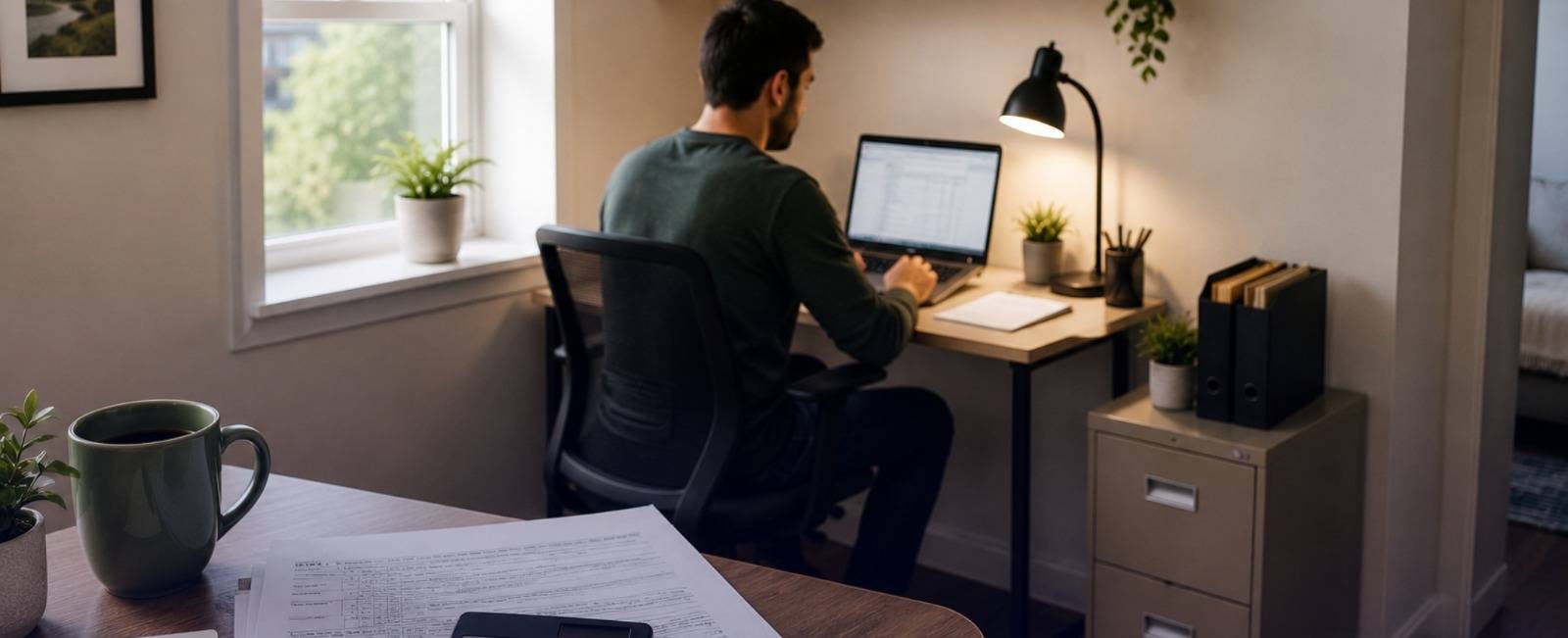
The home-office deduction for three square feet
Have you ever decided your home is simply too small to bother with a home office? This assumption may cost you money every year you hold on to it.
Read this article, you will understand how to qualify for the home-office deduction with a footprint no larger than a single file cabinet – and why the size of your home has almost nothing to do with whether you can claim the home office.
Keep reading. The strategy is simple, and it is court-tested.
Albert Mills successfully defended his home-office deduction in court despite living in an apartment of only 422 square feet.
You will find out:
- How you can make this strategy work for you, and
- How the mini home office can be a big deduction generator.
Small space, big deductions
The home-office deduction creates tax savings for you in two ways. It allows you to deduct
- A percentage of your home expenses, such as rent, mortgage interest, property taxes, and utilities; and
- The business miles you drive back and forth from the principal office in your home to your office outside the home.
Example. Suppose you work in an office 15 miles from your home. When you set up a home office as a principal place of business, you turn the personal commuting miles from your home to your second office into business miles.
With the 2026 standard mileage rate of 72.5 cents per mile, the reclassification of your commute as business travel creates a $21.75 deduction for each round-trip drive between your home office and your second office. If you make this drive five days a week for 50 weeks, then you add an extra $5,437.50 in deductions that you would not have had without the home office.
One note for today’s law: this deduction belongs to the self-employed, partners in partnerships, and corporate employee-owners whose corporations reimburse the expenses under an accountable plan.
The One Big Beautiful Bill Act made permanent the rule that W-2 employees cannot write off a home office, but it left this commuting strategy filly intact for anyone who runs a business.
Make Your Home Office The Principal Place Of Business
Everything above depends on one requirement: your home office must be your principal place of business. That is what turns the drive to your downtown office into deductible business travel instead of the non-deductible commute.
This was once a difficult test to meet. In Commissioner V. Soliman, the Supreme Court denied a home-office deduction to an anesthesiologist who did all his paperwork at home but treated patients at hospitals.
Congress later reversed the result. Under current law, your home office qualifies as your principle place of business as long as you use it for the administrative or management activities of your business and you have no other fixed location where you conduct substantial administrative or management work. So your downtime office can be the place where you meet clients, while the file cabinet space in your home remains your principal place of business.
To secure this treatment, do your administrative work in the area where you have the file cabinet. The IRS treats activities such as billing clients, keeping your books, ordering supplies, setting appointments, and writing reports as the administrative and management work that qualifies.
No Walls Needed
To create a home office, you must find an area of your home that you can designate exclusively for business use. This is important. To make the home-office deduction work, you can never use the office space for personal reasons during the tax year.
According to tax regulations, your office space does not have to be an entire room. You can use any part of a room, and you do not have to mark the area with a permanent partition.
Break For Small Homes
The IRS and the courts recognize that the exclusive use rule can be difficult for owners of small homes, and they forgive you for what they call “de minimis” personal use.
In practice, this means you can set up your office in an area that you must walk through for personal reasons.
For example, in the Hughes case, the court allowed the taxpayers to have his office in a walk-through closet, even though he had to pass through the space to get to the bathroom.
Personal Use That’s Not De Minimis
The courts deny the de minimis exception in situations where a taxpayer uses the space to store personal items or uses the space occasionally to host family meals.
Think of the de minimis rule as a walk-through rule: If you simply pass through the area, you can use if for office space. If you use the space for personal reasons, you probably violate the exclusive use rule.
The Three Square Foot Office
Here is how to create one
Buy a file cabinet that extends all the way to the floor. A typical file cabinet measures about 18 by 24 inches, so it takes up only about three square feet of floor space. Use the cabinet only to store business items, such as files and business supplies.
Set a table or desk beside the cabinet and use it as your workspace while working from home. When you are done, simply move the table away to free up the area.
You can engage in personal activities everywhere except the cabinet space.
When claiming the home office deduction, report only the floor area occupied by the cabinet—its 18-by-24-inch footprint—or the portion of your space that you used exclusively for business.
Key point. Claim only the area used “exclusively” for business use.
Although, this mini office will not create big deductions for your home expenses, it could have a huge impact on your deductible vehicle expenses.
FAQs
There is no minimum size requirement. Your home office can be as small as the space occupied by a floor-standing file cabinet, provided it is used exclusively and regularly for business.
For 2026, the standard mileage rate is 72.5 cents per business mile. For example, a 30-mile round trip between your home office and another business location could generate a deduction of $21.75 per day.
Your home office generally qualifies as your principal place of business if:
- You regularly use it for administrative or management activities, and
- You have no other fixed location where you perform substantial administrative or management work.
BergerCPAFirst, with over 30+ years of experience, offers comprehensive tax preparation services for individuals and businesses nationwide. Our commitment is to provide personalized attention while ensuring compliance and maximizing tax benefits. If you have any questions or would like to schedule a consultation, please call (201) 587-9200 or send us an inquiry.
Recent Post