Client Login

Tax deduction for classic or antique cars used in business
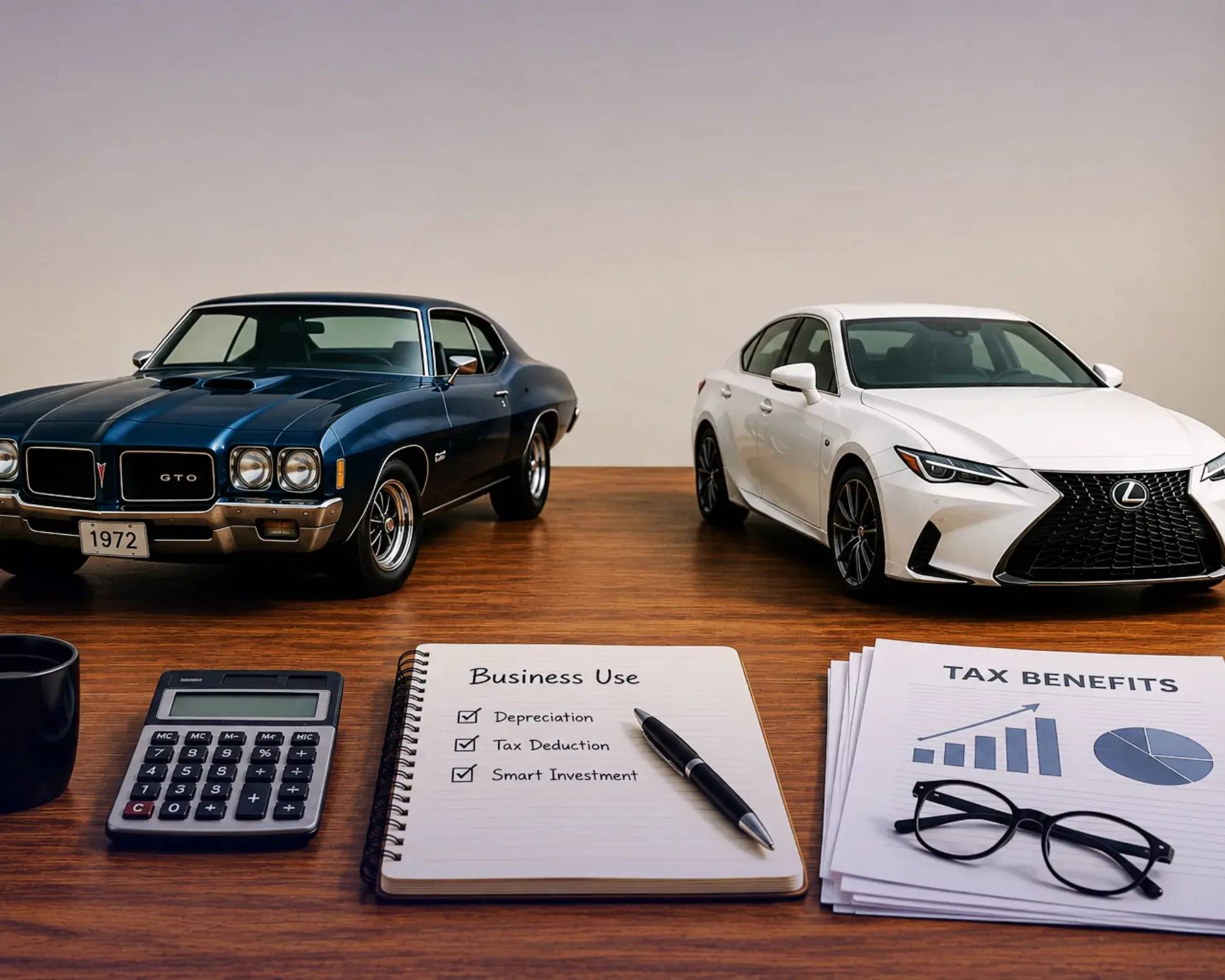
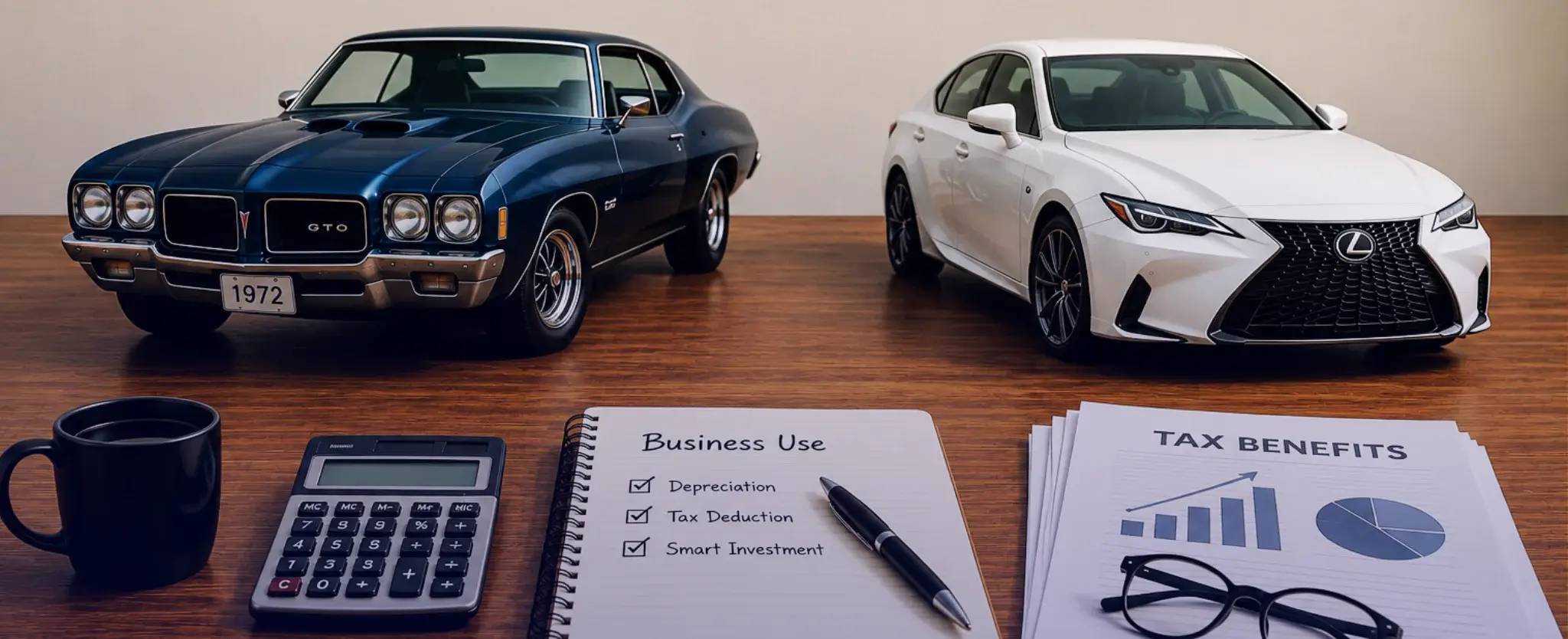
The article is about buying antique cars for use in a business. Here is an interesting question on buying an antique or classic car versus a new car as a business-use vehicle. Let’s say, a 1972 Pontiac GTO versus a 2026 Lexus IS.
Answer
Our answer considers
- The classic or antique car as a write-off;
- How the old law often disallowed classic cars;
- How the new law works to your benefit;
- What the IRS thinks of this;
- Why the term “recovery property” makes this possible;
- How you are shielded from an IRS attack; and
- How the classic car shows you the money.
Classic or antique car as a write-off
To deduct the classic or antique car,
- The car must be of a type that’s subject to wear and tear, decay, decline, or exhaustion; and
- The car must be used in your trade or business.
According to the court, this language is unequivocal (i.e, it allows for no doubt or misinterpretation).
There is no question that driving the 1972 GTO in the course of your business would subject that car to wear and tear, decay and exhaustion.
Old Law
In 1981, lawmakers simplified depreciation deductions and removed the requirements of “salvage value” and “estimated useful life,” both of which could have prevented your write-off of the GTO
New Law
As a result of the 1981 changes, both Brian P.Liddle and Richard Simon won tax deductions for rapidly appreciating almost 300-year-old rare violins and violin bows coveted by collectors.
The courts noted that although the violins and bows would not have been depreciable under pre-1981 law, depreciation simplification in the 1981 law enabled the deduction for antique violins and bows that were used by musicians.
IRS Position
In this Action on Decision 1996-009, the IRS said that it would not follow the Liddle and Simon case and that it expected to bring a case in a different circuit. The IRS wanted to create a different result so it could appeal antique depreciation to the Supreme Court in the hope that the court would rule that antiques are no longer deductible.
We have to point out that for the past 30 years, the IRS has not found a conflicting case to bring to trial, much less one that might produce a result different from Liddle and Simon.
Removal of the Term “Recovery Property”
The taxpayers in Liddle and Simon won their cases based on a 1981 law that created the term “recovery property” as a replacement for the term “depreciation.”
A 1986 law deleted the term “recovery property” from Section 168 depreciation, but as the court noted in Selig, that change did nothing to impact the favorable result for antique depreciation in Liddle and Simon.
In Selig, a court case that involved post-1986 law and that triggered the IRS Action on Decision, the court stated that it would follow Liddle and Simon. As a result, if Selig could show that the exotic automobiles he desired to depreciate were subject to exhaustion, wear and tear, or obsolescence, he could then depreciate them.
Shield against IRS attack
The IRS does not like to bring a case to court that it will lose.
Further, should the IRS bring a case where its position is “not substantially justified”, then you can collect attorney fees and court costs from the IRS if your net worth is less than $2 million.
If the IRS has lost in courts of appeal on substantially similar issues, then the IRS is automatically presumed to be “not substantially justified” and you win attorney fees and court costs.
Thanks to the Liddle and Simon decisions, you now have strong protection. If the IRS challenges your 1972 GTO tax deductions, you are likely to recover attorney fees and court costs. In short, the IRS is unlikely to pursue a dispute over those deductions because its chances of prevailing are remote.
Show me the money
Thank the One Big Beautiful Bill Act (OBBBA) for making the money equation easy. The OBBBA, enacted on July 4, 2025, permanently restored 100% bonus depreciation for qualifying property acquired and placed in service after January 19, 2025, reversing the phase-down that had reduced bonus depreciation to 40% in 2025 and would have lowered it to 20% in 2026 and to zero in 2027.
And just as under the Tax Cuts and Jobs Act (TCJA) before it, the law uses the same depreciation schedule for both new and used cars, so you encounter no depreciation differences between the 2026 Lexus IS and the 1972 GTO.
One caveat keeps the number honest. Because both the GTO and the Lexus are passenger automobiles-four-wheeled vehicles rated at 6,000 pounds or less-they fall under the Section 280F luxury-auto caps, which limit how much depreciation you can claim each year regardless of bonus depreciation.
For a vehicle in service in 2026 and eligible for bonus depreciation, your first year deduction is capped at $20,300, them $19,800 in year two, $11,900 in year three, and $7,160 for each year after that. So even with 100 percent bonus depreciation restored, you can’t write off the full price of either car in Year One. The good news for your comparison: the cap applies identically to both vehicles, so it doesn’t till the new-versus-used decision.
Of course, we expect that you will incur more repairs and higher operating costs with the 1972 GTO than with the 2026 Lexus IS.
But after, say, five years of use, you should be able to sell the 1972 GTO for much more than you could sell the Lexus, which will decline to about 40 percent or so of the $50,000 you would pay for it.
In other words, your GTO could give you a profit of, say, $30,000 to $50,000 compared with the Lexus.
FAQs
Potentially, yes. If the vehicle is used for business purposes and meets the applicable tax requirements, it may qualify for depreciation just like a newer business vehicle.
Before 1981, depreciation rules required taxpayers to consider factors such as salvage value and estimated useful life, making it difficult to depreciate appreciating assets like antiques.
No. Courts have concluded that removing the term “recovery property” from the depreciation statute in 1986 did not overturn the reasoning that allows depreciation of qualifying business-use antiques.
BergerCPAFirst, with over 30+ years of experience, offers comprehensive tax preparation services for individuals and businesses nationwide. Our commitment is to provide personalized attention while ensuring compliance and maximizing tax benefits. If you have any questions or would like to schedule a consultation, please call (201) 587-9200 or send us an inquiry.
Recent Post